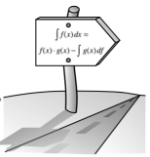
7.4.3Can I use integration by parts again?

Integration by Parts with Substitution

7-199.

Review your summary of the integration by parts method, from problem 7-191. Then, with your team, evaluate the integrals below. 

  1. xsin(x)dx 

  1. x(3x5)100dx 

7-200.

PLAY IT AGAIN, SAM

Samantha tried to use integration by parts for the integral x2exdx. She started with f=x2 and dg=exdx. Follow her work below.

f=x2

df=2xdx

dg=exdx

g=ex

Therefore,

x2exdx=x2ex2xexdx

​​

  1. Samantha’s new integral appears nicer than the original. However, it still contains a product. What should Samantha do next?  

  2. Finish her work to evaluate x2exdx.

  3. Evaluating x2exdx required using the integration by parts process twice. How many times does the integration by parts process need to be used to evaluate x5exdx? Explain your thinking.    

  4. Similarly, evaluate x2sin(x)dx

7-201.

REAPPEARING ACT

Elise is trying to evaluate exsin(x)dx using integration by parts and is getting frustrated. No matter what she assigns to f and dg, none of the terms seem to disappear. The new integral always contains ex and either sin(x) or cos(x). Her teammate, Edward, notices that when she uses the process twice, the new integral looks familiar. Edward thinks this might be a step in the right direction. Examine their work:

f(x)=ex    

df=exdx

dg=sin(x)dx

g(x)=cos(x)

Therefore:
exsin(x)dx=excos(x)+excos(x)dx

Using the process again: 


f(x)=ex

df=exdx

dg=cos(x)dx

g(x)=sin(x)

exsin(x)dx=excos(x)+exsin(x)exsin(x)dx

Solve Elise’s equation for exsin(x)dx .    

7-202.

Examine the following integrals. Some are easier to evaluate by using the substitution method, while others require integration by parts. Evaluate each integral and briefly describe your method.

  1. 2x3ln(x4)dx 

  1. xsin(5x)dx 

  1. 3e2xcos(x)dx 

  1. sec3(x)tan(x)dx 

  1. x2sin(x)dx 

  1. x3sin(x)dx 

Review and Preview problems below

7-203.

Sketch the graph of f(x)=3x2+5x2x . Write an equation for its end behavior function. Homework Help ✎

7-204.

y=f(x) satisfies dydx=2x and its graph contains the point (1,5). Homework Help ✎

  1. Use Euler’s Method to sketch an approximation of y=f(x) over 1x1. Use Δx=0.5.

  2. Use implicit integration to solve the differential equation.

  3. Compare your answers to parts (a) and (b). Determine the largest difference between the actual y-value and the Euler’s Method y-value for x=1, 0.5, 0, 0.5, and 1. This largest difference estimates the error of Euler’s Method. If Δx=0.1 instead, do you think this error will be larger or smaller?

7-205.

Solve for x if dxdt=x+1 and x=0 when t=2. Confirm that your solution is correct by substituting into the differential equation. Homework Help ✎

7-206.

Examine the integrals below. Consider the multiple tools available for integrating and use the best strategy for each part. Evaluate each integral and briefly describe your method. Homework Help ✎

  1. 13dxx 

  1. tan1(x)dx 

  1. sinxdxx 

  1. π/3π/2csc2(x)dx 

7-207.

Evaluate each of the following limits. Homework Help ✎

  1. limx1ln(x)x21 

  1. limx0+(1+5x)2/x 

7-208.

If (a2)x+2b=3+5x is true for all values of x, what are the values of a and b? Homework Help ✎

7-209.

Multiple Choice: A point is moving along a curve y=f(x). At the instant when the slope of the curve is 13, the x-coordinate of the moving point is increasing at a rate of 5 units per second. The rate of change, in units per second, of the y-coordinate of the point is: Homework Help ✎

  1. 53 

  1. 13 

  1. 13 

  1. 53 

  1. 35